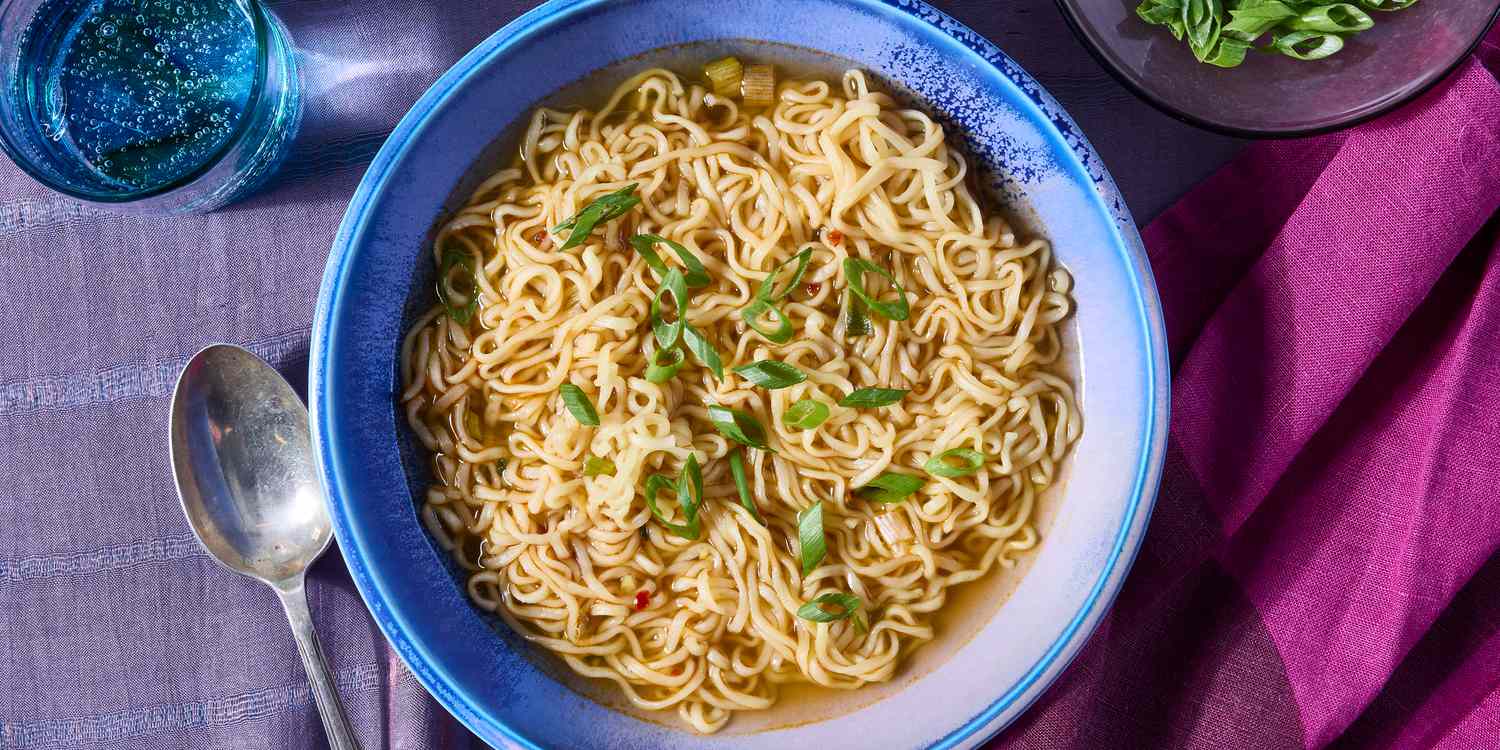
I’ve cooked for television. I’ve cooked for judges and I’ve even cooked for chefs who scare me a little. And yet one of my family’s (Ok, my children’s) most requested dinners starts with a 99-cent packet of instant ramen that lives in the back of my pantry.
This is not about nostalgia or desperation cooking. This is about respect. Ramen doesn’t taste good or bad on its own—it reflects how it’s treated
Right off the bat I’ve learned that ramen broth is a bit timid. If you just dump the seasoning packet into boiling water and call it a day, you get something thin, salty and quite sad. Instead, I use less water than the package tells me to and let that broth simmer down. When you reduce it, the flavors stop whispering and start talking. Suddenly the soup tastes intentional.
From there, everything changes.
How I Upgrade Instant Ramen
Nicole Russel
First, eggs are non-negotiable in my house. Sometimes I whisk one directly into the simmering broth for a silky, almost custardy texture. Other nights, I crack it in whole and let the white barely set while the yolk stays molten and ready to enrich the soup when stirred in. My kids think this is fancy; I let them believe that.
Scallions are the obvious upgrade, but how you treat them matters. I slice the whites thin and cook them briefly in a little oil before the broth goes in. That quick sauté knocks out the sharp edge and builds a base that tastes cooked, not raw. The green tops go on at the end for freshness and color, because ramen should look like someone was paying attention.
Sesame oil is the smallest detail with the biggest payoff. Not a pour…just a drizzle. Too much and it tastes like a candle shop. Just enough and the whole bowl suddenly smells like a place you want to be. On nights when I want extra richness I add a small pat of butter at the end (I do this with pretty much all of my dishes). It melts into the broth and gives it a round, luxurious finish.
Sometimes I lean into what I have in the fridge. Leftover rotisserie chicken gets shredded and warmed in the broth. Frozen corn adds sweetness and texture. A spoonful of chili crisp turns the soup spicy and crunchy in the best possible way. I’ve even dropped in a slice of American cheese once, which sounds wrong until you try it. It melts into the broth and gives it an almost creamy depth that feels suspiciously good!
Finally, I’ve also learned that the foundation of a memorable bowl starts with the noodle itself. That’s why I reach for something like A‑Sha Tainan Style Noodles instead of the basic stuff you find at the bottom of the pantry. These are air-dried, never fried, made with nothing more than wheat, salt, and water. Plus they actually have chew and texture when they hit the broth. Typical 50-cent noodles are mostly there to soak up water, but a quality dry noodle holds up to cooking and stays springy in the broth, so every forkful feels like it belongs in a real ramen bowl rather than a cafeteria tray.
Remember, the real magic is slowing down just enough to let the ramen feel cooked with care. I don’t rush it. I taste the broth. I adjust it. I let the noodles finish cooking in the soup instead of draining them like an afterthought. The result is a bowl that tastes layered, rich, and comforting, not like something you ate hunched over a sink in college (sadly, I’m looking at myself here).
When I set these bowls down at the table, nobody asks how much it cost. They just slurp. There is a brief silence followed by someone asking if there’s more.
That’s the secret. Ramen doesn’t need rescuing. It just needs attention. And maybe a little butter.